
We are working as an integrated system across health and both local authorities.
Yes, we are commissioning black and minority ethnic VCSE organisations. Please see our response to Pledge commitment 1.
We have commissioned services specifically for ethnic minority clients (Core Arts, Growing Minds and Open Minds).
The Growing Minds project is comprised of four different components:
Ø Family Action Counselling Service
Ø Non-Violent Resistance (NVR) Parenting (a 12-week parenting programme)
Ø Tree of Life programme for young people between 11-18 years of age
Ø Mental Health First Aid Instructor Training
The project has been running for over 1.5 years and was commissioned to provide emotional wellbeing support to young people and parents from African and Caribbean backgrounds.
Update on Growing Minds
Please see the summary below:
Growing Minds has been evaluated by an external evaluation company (Fiveways) and the initial results are shared here. Plans are currently being discussed to explore what parts of the programme will be carried forward and how, based on the findings from the evaluation report.
The Family Action Therapy Service
This service offered up to 16 sessions of “active” counselling for children and young people from African and Caribbean Heritage (ACH) backgrounds delivered by an ACH counsellor. A total of 123 people received this service and completed their support sessions between February 2020 and February 2022.
All participants in the qualitative research (5) reported that they had a very good experience of the therapy and it had left a lasting impact on their lives. Since having therapy, they have seen the good days outnumber the bad days. This qualitative feedback is supported by the quantitative service monitoring data:
The Non-Violent Resistance (NVR) Training
The NVR programme (sometimes re-named “Tools for Teenage Years” by partners) was for parents whose children may be experiencing emotional wellbeing or behavioural challenges at home or at school. The 12-week programme focuses on topics such as de-escalation, parental presence, reconciliation gestures, and understanding both children’s and parents’ trauma. Thirty-five parents/carers accessed the first two tranches of NVR training delivered by community partners up to January 2022.
The Tree of Life in Schools
The aim of the Tree of Life element of Growing Minds is to give space to young people from ACH backgrounds to believe in their own abilities, acknowledge their dreams and talk about difficult experiences in a safe environment.
Tree of Life is delivered by Peer Leaders from the community in school settings with groups of young people aged 11-18.
The pilot is still ongoing and the results will not be finalised until the end of the pilot in July 2022, but the initial findings show that all the schools that participated (10 secondary schools out of 14 approached) are requesting a second and third group within the first year of the pilot.
Focus groups are being carried out in three schools. The results have not been analysed yet, but early quantitative data from the pre and post questionnaires completed by students (52) show:
In addition:
Update on data:
Overall, data completeness has improved over time. There is room for improvement around the collection of data on sexuality, disability and wider determinants of health.
Feedback from the City and Hackney Integrated Care Partnership Communications and Engagement Enabler Group, held on 9 March 2022, included improving communication with service users about why the data is being collected, how it will be used and ensuring language is not a barrier.
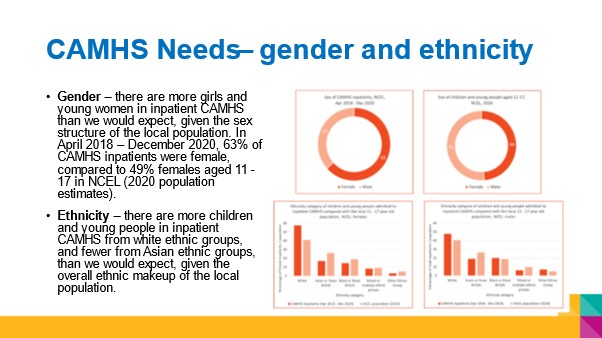
Please see the charts below for data on CAMHS and IAPT services:

Other areas of progress
North East London CCG (City & Hackney) was the most successful CCG in the UK, achieving the highest percentage of National Health Service England (NHSE) health checks for people with severe and enduring mental illness. People from ethnic minorities are overrepresented within this group.
Within LBH, the Diversity and Inclusion Leads have implemented an innovative approach to addressing racialised trauma among staff, following feedback from peer support sessions. The feedback for these sessions has been overwhelmingly positive, and we are seeking to share the learning from this approach with local partner organisations.
Update: The Street Outreach Team has been recurrently commissioned with extended hours. We have again managed, despite Covid, to achieve the completion of 60% of serious mental illness (SMI) health checks.
Objectives of this work include:
Update: We have done a large analysis of our IAPT provider referrals. We are in the process of looking at the analysis in detail, but of immediate concern are the numbers dropping out of treatment – which are higher in BAME groups. We can report in more detail in our next update.
We have a strong voluntary sector partnership in City and Hackney.
Key outcomes include:
Although we are pleased with having comparatively good recovery rates for treatment, as previously mentioned, these are still not equitable with the general population, and we need to improve our ethnicity coding.
Update: A pharmacy project was initiated with Irie MIND to address service users’ concerns about SMI medication. This proved to be very successful and we hope to carry on this dialogue within the PCNs .
East London NHS Foundation Trust (ELFT) inequality project
Marie-Michelle Mousse, Project Manager, Community Mental Health Transformation Programme, ELFT, said:
Part of ELFT’s strategy is to improve the quality of life for all we serve, improve experience of care for service users, and one of the trust’s priorities for 2021-22 is around Race, Privilege, Equality and Diversity.
The trust is committed to challenging prejudice and discrimination wherever this affects service users and staff, and putting equality and diversity at the heart of our organisation’s culture.
The trust has launched a Quality Improvement programme on Pursuing Equity, and it has been designed in partnership with Public Health, People Participation, the Service User Lead Team, the trust’s networks and the Quality Improvement Department. The programme is supporting over 30 teams across the trust, those wanting to use Quality Improvement methodology to tackle an aspect of equity in their area of work.
Below are other developments taking place in ELFT:
We will be able to update on the work of the BAME implementation group in the next progress report.
Challenges: Obviously, Covid has been our biggest challenge. We have not had time as a system to participate nationally as much as we would like. In addition, major changes within the CCG, which has now become part of North East London, are very recent and need time to settle.
Update: We are now moving to becoming an Integrated Care System, and the system is committed to contributing to national campaigns
Challenges
Update: We have obtained funding for a five to thrive Wellbeing Worker to promote the five ways to wellbeing within voluntary sector groups, many of which work with minority ethnic groups.
Dr Anu Kumar, Clinical Lead for Patient Participation and Involvement, Inequalities and Sustainability for the Integrated Care System (ICS) is setting up a conference locally to address inequalities.
He said: “The ICS in Hackney and the City of London brings together partners from different cultures delivering health and social policy. This Inaugural Conference seeks to embed shared principles of Equity, devise ways of working across traditional boundaries and uncover gaps so as to work more effectively going forward.”
Update on supporting research or policy:
Anna Garner, North East London CCG Inequalities Lead, said: “We want to improve collection of data by services and organisations on equalities dimensions so that we have robust data to identify where there are inequalities in access to, experience of and outcomes from services. We are conducting a review to look at where inequalities data is being collected by services, how complete this is and where there are gaps. We are hoping to identify system-wide recommendations on:
We continue to support Synergi and use the NHS Race & Health Observatory for support to make local decisions around inequalities.
We are also members of the Inequalities Health Alliance: https://www.rcplondon.ac.uk/projects/inequalities-health-alliance
On Thursday 25th November 2021, the Synergi National Pledge Alliance was launched (virtually) in response to Pledge commitment 4: To provide national leadership on this critical issue, which you can find out more about here.
The Alliance’s primary aims are to:
We are happy to share ideas and outcomes of work.
Our Integrated Care System will continue to address inequalities as our highest priority, and reducing inequalities for different ethnic groups within mental health services is a key part of our strategy.